
Have you ever been told by your dentist that a tooth needs to come out — and immediately felt your stomach drop? You’re not alone. The words “tooth extraction” are enough to make most people nervous. But here’s something that might surprise you: the tooth extraction process is far more straightforward and comfortable than most people imagine. Once you understand exactly what happens, step by step, that fear tends to shrink considerably. So let’s walk through everything together no scary jargon, no sugarcoating, just the honest, clear truth about what happens during a tooth extraction.
Why Would You Need a Tooth Extraction?
Dentists don’t recommend pulling a tooth lightly. It’s always a last resort. The most common reasons include:
- A tooth that is too severely decayed to be saved with a filling or crown
- A broken tooth where the damage goes below the gum line
- Impacted wisdom teeth causing pain or crowding
- Gum disease that has loosened the tooth beyond repair
- Overcrowding that needs to be corrected before orthodontic treatment
If any of these apply to you, a tooth removal procedure may genuinely be the best thing for your overall oral health.
Simple vs. Surgical Extraction — What’s the Difference?
Not all extractions are the same. A simple tooth extraction is used for teeth that are visible and accessible. The dentist loosens the tooth and removes it with forceps — clean and relatively quick.
A surgical tooth extraction is needed when a tooth is broken, impacted, or below the gum line. A small incision is made in the gum, and sometimes a tiny portion of bone is removed to access the tooth. This sounds intimidating, but with proper anesthesia, patients are comfortable throughout.
Wisdom teeth often fall into the surgical category, which is why they have a slightly longer recovery.
What Happens During a Tooth Extraction — Step by Step
This is what most people really want to know. Here’s the full tooth extraction process, broken down simply:
Step 1 — Numbing the Area Your dentist applies a local anesthetic near the tooth. You’ll feel a small pinch from the injection, and within a few minutes, the entire area goes numb. You will feel pressure and movement during the procedure — but not pain. That distinction matters more than anything else.
Step 2 — Loosening the Tooth Using a small instrument called an elevator, the dentist gently rocks the tooth back and forth. This widens the socket and separates the tooth from the surrounding ligament. Most patients are surprised by how quick this step is.
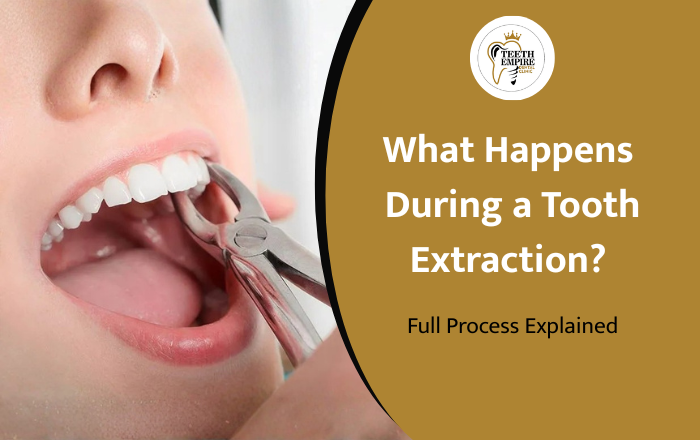
Step 3 — Removing the Tooth Forceps are used to grip and remove the tooth with a firm, controlled motion. For a simple extraction, this often takes less than two minutes. The sounds can feel strange, but remember — you’re numb.
Step 4 — Cleaning and Closing The socket is cleaned out, and a piece of gauze is placed for you to bite down on to control bleeding. For surgical extractions, a stitch or two may be placed. Bleeding typically slows within 20–30 minutes.
Does a Tooth Extraction Hurt?
This is the big question. During the tooth extraction procedure, you should not feel pain — only pressure. If at any point you do feel pain, tell your dentist immediately. The anesthesia can be topped up without any issue.
After the numbness wears off, mild soreness is normal for 2–3 days. Over-the-counter pain relievers and an ice pack in the first 24 hours handle this well for most people.
One complication worth knowing about is dry socket — this happens when the blood clot that forms in the socket gets dislodged. It causes noticeable throbbing pain around day 3 or 4. It affects roughly 2–5% of routine extractions but is completely treatable, so don’t panic if it happens. Just call your dentist.
Recovery Tips That Actually Make a Difference
The tooth extraction recovery period is short for most people — 1 to 3 days for simple cases. Here’s what helps:
- Do not use a straw for at least 48 hours — the suction can disturb the clot
- Stick to soft foods like yogurt, soup, and mashed potatoes
- Avoid smoking for at least 72 hours
- Rinse gently with warm salt water after the first 24 hours
- Don’t poke the socket with your tongue or finger
Most people are back to their normal routine within 2 days. Wisdom tooth extractions may take a few days longer.
Ready to Get It Done? Visit Teeth Empire Dental Clinic in Kharadi
If you’ve been putting off a tooth extraction because of fear or uncertainty, now you know there’s nothing to dread. The procedure is routine, well-managed, and over faster than most people expect.
For anyone in Kharadi and nearby areas of Pune, Teeth Empire Dental Clinic is a trusted name for safe and comfortable tooth removal. Led by Dr. Prithvi Bonde (MDS), the clinic offers a calm, patient-friendly environment where your comfort is the priority — from your first consultation to your final follow-up.
Don’t let tooth pain wait. Book your consultation with Dr. Prithvi Bonde at Teeth Empire, Kharadi today and take the first step toward a healthier, pain-free smile.
Name – Teeth Empire Dental Clinic Kharadi – Dr. Prithvi Bonde
Address: Office No. 106, 1st floor, Zen Square 2, Panchshil Towers Rd, opposite EON Free Zone, Vitthal Nagar, Kharadi, Pune, Maharashtra 411014
Phone:089994 21629
FAQs About Tooth Extraction
Q1. How long does a tooth extraction take?
A simple tooth extraction usually takes 20–40 minutes. Surgical cases may take up to an hour.
Q2. Can I eat before my appointment?
Yes, for local anesthesia procedures, a light meal beforehand is perfectly fine.
Q3. When can I eat normally again?
Soft foods for the first 2–3 days, then gradually return to your normal diet as comfort allows.
Q4. Is it normal to have a hole after extraction?
Completely normal. The socket fills in naturally with new bone over the following weeks and months.
Have questions? We’re just a message away! Contact us on WhatsApp — Click Here to Chat with Us